shakespeare agecroft1

Tuesday, December 18, 2012
Looking for wisdom
In light of the recent tragedy in Newtown, Connecticut, the words of an African-American street person in New York spring to mind. In the aforementioned Shakespeare-related 1996 documentary film by Al Pacino, Looking for Richard, Pacino is speaking with people on the streets of New York City about Shakespeare, and about the playwright's relevance to the world we live in today. This one man-on-the-street response was perhaps the most thought-provoking moment of the entire film:
"Intelligence is hooked in with language. When we speak with no feeling we get nothing out of our society........We don't feel for each other, that's why it's easy to get a gun and shoot each other. If we were taught to feel, we wouldn't be so violent......Shakespeare did more than help us. He instructed us."
The expression of feeling through language is one of humanity's most precious assets: it is not to be trivialized, not to be wasted, not to be scorned.
"My words fly up, my thoughts remain below.
Words without thoughts never to heaven go."
Hamlet (III, iii)

Tuesday, December 11, 2012
We band of brothers
"We few, we happy few, we band of brothers;
For he today who sheds his blood with me
Shall be my brother......"
Henry V (IV, iii)

The Shakespearean lines quoted above are among the most memorable ever written on the visceral emotions of human conflict: they've been used to hearten troops in wars as recent as our involvement in Iraq and Afghanistan. During World War II, Winston Churchill asked Laurence Olivier for a film version of Henry V as a means of bucking up the spirits of the English people and its soldiery in the face of Nazism. In more recent years, film director Steven Spielberg used "Band of Brothers" as the title of a series depicting an American fighting unit making its torturous way from the beaches of Normandy into the heart of Hitler's Europe.
Pictured above is some of the armor, primarily from the 16th and 17th centuries, in the collection of Agecroft Hall. Earlier versions of essentially the same sort of breastplates and backplates would have protected some of the English warriors and their French counterparts at the battle of Agincourt, where Henry V made himself legendary in 1415. The English had already proven victorious against the French at Crecy and Poitiers; Agincourt produced more icing for a very sweet cake.
The fact that the French, led for a time by Joan of Arc, later drove the English out of France would have to be related in a messier tale: the sad reign of Henry VI, years that saw England lose continental territory and tear itself asunder under a pious but weak king. Shakespeare found enough of a mess to make up a three-parter.
Shakespeare's Henry V has almost always been regarded as a patriotic play, extolling the virtues of England's fighting spirit. But one very talented critic begged to differ. Harold C. Goddard, who headed the English department at Swarthmore College from 1909 until 1946, wrote a book on the works of Shakespeare but died before giving his book a title. His publishers called it The Meaning of Shakespeare. An admiring and perceptive commentator, the late Joseph Sobran, wrote that a better title would have been The Spirit of Shakespeare, since each reader of the playwright would and should create a personal interpretation of the meaning of the poet's works.
Goddard maintained that Shakespeare, in writing Henry V, was adhering to personal convictions that emerge repeatedly in his histories and tragedies: that the use of force ultimately does not prevail and in fact drags human souls into darkness. As Goddard points out, a Romeo swept up in ancestral feuding ultimately did not help himself or his Juliet; Hamlet left enormous carnage in his wake (including his beloved Ophelia) after heeding the ghost of his father. The territorial gains of Henry V were wisps in the wind.
Shakespeare, Goddard believed, was convinced that giving in to the aggressive, violent side of man's nature, often urged on by atavistic sources, only led down a winding road to catastrophe. Goddard's take on Shakespeare is both surprising and magnificent, and gives Shakespeare's works a unity and coherence that so many literary critics fail to grasp.
Tuesday, December 4, 2012
Home is the soldier
".......Well said, courageous Feeble! Thou wilt be as valiant
as the wrathful dove or most magnanimous mouse."
Henry IV, Part II (III, ii)
Despite his rotund self-absorption, Shakespeare's Falstaff has been given the responsibility of recruiting soldiers for an army, to help the ailing King Henry IV fight another outbreak of rebelliousness. True to his overinflated form, Falstaff sees his chance for personal gain: he'll pocket the bribes of the fit and able and recruit instead the weak, the ragged, the hopelessly pathetic. He'll make out like a bandit, figuring no one will be the wiser: he recruits the bedraggled Feeble, Shadow, and Wart.

More dependable soldierly types are depicted in the top row of the carved oak panel above, which adorns a wall in Agecroft Hall's Great Hall. The panel is believed to have been carved in the first half of the sixteenth century, perhaps during the lifetime of Agecroft's owner Robert Langley. The carving style may point to either Italian or German workmanship. It's worth remembering that even in sixteenth-century Tudor England, owning goods that were obtained from abroad translated into status. Such possessions gave owners a chance to sneer at domestic craftsmanship, regardless of its quality. Some things never change.
And oak, as a wood choice, appealed to the English: it was durable as a rock, and carving it well involved considerable skill. On the Sceptered Isle, they seemed to like virtually all of their furnishings done in oak.
Agecroft's carvings include (on the bottom row) what has been called the romayne style, a Renaissance decorative motif featuring heads in medallion-like profile, often carved into furniture and paneling. It's a style first introduced into England from Italy during the reign of Henry VIII; the word "romayne" was current in England at the time as applying to anything Roman or Italian. Whether these four particular figures were meant to have specific identities is uncertain.
Regarding the military types depicted in the top row (even the piper at far right has weaponry), research done at Agecroft Hall suggests the possibility that they represent retainers of a noble house "chosen to serve as defenders should occasion require it." If so, it is a reminder of the inherent violence of the Tudor age, when there was little sense of ease or safekeeping without some form of armed protection.
No doubt Falstaff would have let these men avoid their warlike duties in return for a few clinks of coinage.
as the wrathful dove or most magnanimous mouse."
Henry IV, Part II (III, ii)
Despite his rotund self-absorption, Shakespeare's Falstaff has been given the responsibility of recruiting soldiers for an army, to help the ailing King Henry IV fight another outbreak of rebelliousness. True to his overinflated form, Falstaff sees his chance for personal gain: he'll pocket the bribes of the fit and able and recruit instead the weak, the ragged, the hopelessly pathetic. He'll make out like a bandit, figuring no one will be the wiser: he recruits the bedraggled Feeble, Shadow, and Wart.
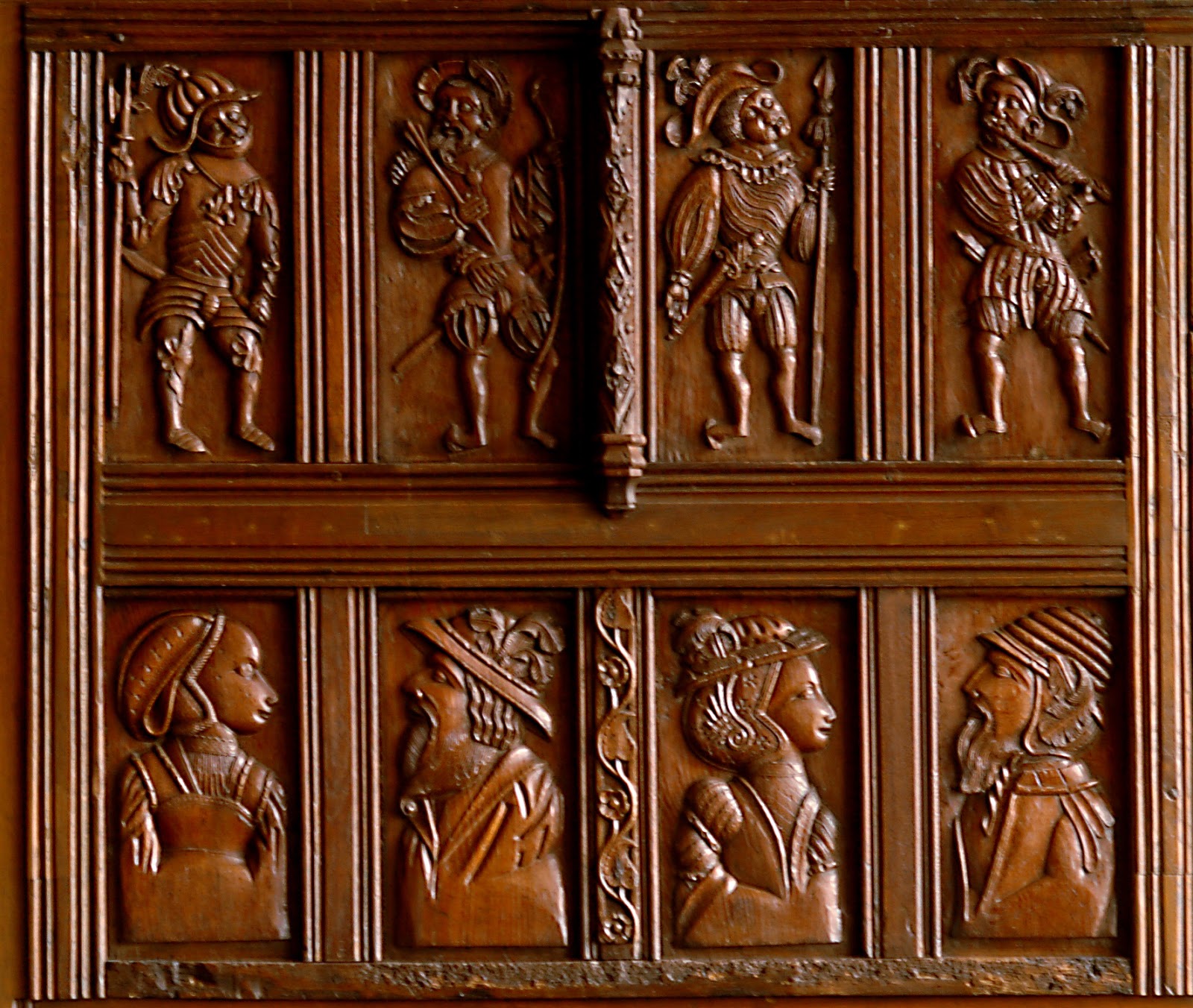
More dependable soldierly types are depicted in the top row of the carved oak panel above, which adorns a wall in Agecroft Hall's Great Hall. The panel is believed to have been carved in the first half of the sixteenth century, perhaps during the lifetime of Agecroft's owner Robert Langley. The carving style may point to either Italian or German workmanship. It's worth remembering that even in sixteenth-century Tudor England, owning goods that were obtained from abroad translated into status. Such possessions gave owners a chance to sneer at domestic craftsmanship, regardless of its quality. Some things never change.
And oak, as a wood choice, appealed to the English: it was durable as a rock, and carving it well involved considerable skill. On the Sceptered Isle, they seemed to like virtually all of their furnishings done in oak.
Agecroft's carvings include (on the bottom row) what has been called the romayne style, a Renaissance decorative motif featuring heads in medallion-like profile, often carved into furniture and paneling. It's a style first introduced into England from Italy during the reign of Henry VIII; the word "romayne" was current in England at the time as applying to anything Roman or Italian. Whether these four particular figures were meant to have specific identities is uncertain.
Regarding the military types depicted in the top row (even the piper at far right has weaponry), research done at Agecroft Hall suggests the possibility that they represent retainers of a noble house "chosen to serve as defenders should occasion require it." If so, it is a reminder of the inherent violence of the Tudor age, when there was little sense of ease or safekeeping without some form of armed protection.
No doubt Falstaff would have let these men avoid their warlike duties in return for a few clinks of coinage.
Monday, November 26, 2012
Confusion makes a modest masterpiece
"This is as strange a maze as ever men trod...."
The Tempest (V, i)
The shipwrecked Alonso, King of Naples, is scratching his head over the strange but joyful happenings he's witnessed on Prospero's island: his son, given up for dead, is restored to him; his own crass behavior has been forgiven; his mostly disreputable retinue let off with a very mild scolding. He's justifiably baffled, as if stumbling about in a maze that has new wonders around every unexpected corner.

Pictured above is the turf maze at Agecroft Hall. It's almost invariably a highlight for visiting children, who wend their way through its not-too-labyrinthine turns and by trial and error usually make it to the center. The maze was laid out years ago in emulation of similar designs that had become popular during the Tudor period or earlier. There were also labyrinth designs which, in the strictest use of the term, differed from mazes in that they did not involve confusing choices of direction, but were essentially meandering, one-way journeys to a (usually) central destination, which often had a fountain, sundial, or statue.
Labyrinths and mazes had historical antecedents ranging from ancient Crete with its mythological Minotaur to the floor of medieval Chartres Cathedral in France. The cathedral and its labyrinth are to this day a destination of pilgrimmage for religious penitents, medievalists, mystics and the merely curious.
In Shakespeare's age, English society's upper social strata enjoyed formal gardens, often walled in or cloistered to add to the sense of exclusiveness and privacy. A variety of types of mazes were created: one popular style involved using box hedges, sometimes allowed to grow high enough to preclude seeing over, making the correct path more of a mystery. Frustratingly, turf mazes in England and on the European continent tend to be difficult if not impossible to date because they must be periodically recut: neglect quickly leads to oblivion.
Among the finest mazes in England can be found at Hatfield House in Hertfordshire. Its maze is of yew and the hedges stand taller than a man's height, making navigation to its center quite an adventure.
The Tempest (V, i)
The shipwrecked Alonso, King of Naples, is scratching his head over the strange but joyful happenings he's witnessed on Prospero's island: his son, given up for dead, is restored to him; his own crass behavior has been forgiven; his mostly disreputable retinue let off with a very mild scolding. He's justifiably baffled, as if stumbling about in a maze that has new wonders around every unexpected corner.

Pictured above is the turf maze at Agecroft Hall. It's almost invariably a highlight for visiting children, who wend their way through its not-too-labyrinthine turns and by trial and error usually make it to the center. The maze was laid out years ago in emulation of similar designs that had become popular during the Tudor period or earlier. There were also labyrinth designs which, in the strictest use of the term, differed from mazes in that they did not involve confusing choices of direction, but were essentially meandering, one-way journeys to a (usually) central destination, which often had a fountain, sundial, or statue.
Labyrinths and mazes had historical antecedents ranging from ancient Crete with its mythological Minotaur to the floor of medieval Chartres Cathedral in France. The cathedral and its labyrinth are to this day a destination of pilgrimmage for religious penitents, medievalists, mystics and the merely curious.
In Shakespeare's age, English society's upper social strata enjoyed formal gardens, often walled in or cloistered to add to the sense of exclusiveness and privacy. A variety of types of mazes were created: one popular style involved using box hedges, sometimes allowed to grow high enough to preclude seeing over, making the correct path more of a mystery. Frustratingly, turf mazes in England and on the European continent tend to be difficult if not impossible to date because they must be periodically recut: neglect quickly leads to oblivion.
Among the finest mazes in England can be found at Hatfield House in Hertfordshire. Its maze is of yew and the hedges stand taller than a man's height, making navigation to its center quite an adventure.
Monday, November 19, 2012
Better not drink the water, either
"............Hamlet, this pearl is thine;
Here's to thy health.
[Trumpets sound, and cannon shot off within.
Give him the cup."
Hamlet (V, ii)
Hamlet has just scored "a hit, a very palpable hit" in his fencing duel with Laertes. King Claudius, in league with Laertes to kill Hamlet, has put poison in the drinking cup he offers the prince. Had Lady Macbeth been Claudius' wife she might have applauded; her immortal advice to her husband was to "....look like the innocent flower, but be the serpent under't...."

In the collection of Agecroft Hall is an ornate silver covered cup, German in origin and made c1600 (shown above). Most Shakespearean scholars believe that Hamlet was written at about that same time, although many also point to the possible existence of an earlier version of the play, perhaps by Shakespeare himself. In any case, the setting of Hamlet in the sumptuous court of a Danish king makes it easy to imagine such a fine cup as holding the proffered drink that would mean "the present death of Hamlet," doing what England never got its chance to do.
This silver cup is slightly over nine and one-half inches tall, with elaborate ornamentation depicting flowers and fruit. Much of the northern European continent was justifiably well-regarded for the quality of its metalwork, and German craftsmanship was no exception in the eyes of the English. German silver pieces were said to be rarely melted down for reworking due to their quality, according to archival sources.
In Hamlet, when the poisoned cup is offered the Danish prince, he politely declines it for the moment, and Queen Gertrude drinks from the cup instead. Interestingly, like so much of Hamlet, there have been contrasting interpretations of this scene in performance. The more conventional approach has the Queen quite oblivious to the fact that the cup is poisoned: by the time she realizes what has happened, it's too late.
An intriguing alternative interpretation (used by Diane Venora, for example, in the Ethan Hawke film version that was released in 2000) has the Queen, guilt-ridden and suicidal, suspecting the cup to be poisoned and using it to deliberately end her own life. That modernized take on Shakespeare's classic also has Laertes pulling out a pistol when his fencing skills prove inadequate to the task at hand.
Be all this as it may, there's one interpretation that hasn't changed in 400 years: Hamlet's a goner.
Monday, November 12, 2012
Sleep, death's counterfeit
"To note the chamber: I will write all down:
Such and such pictures; there the window; such
the adornment of her bed; the arras, figures...."
Cymbeline (II, ii)
In the middle of the night, as Shakespeare's heroine Imogen sleeps, sly Iachimo emerges from hiding in a large trunk that he has persuaded Imogen to have placed in her own bedchamber for safekeeping. He is already convinced of Imogen's undying loyalty and devotion to her husband; but to win a wager with that husband Iachimo needs to have some convincing proof that he's slept with her. He figures that a detailed description of her bedchamber, of a mole on her left breast, and a stolen bracelet should do the trick. And it does, for a time.


Believed to be numbered among Shakespeare's last dramatic works, his play Cymbeline is set in the misty age of British resistance to imperial Roman hegemony. It might be a bit surprising to recall that in the playwright's own day, beds were not always located in rooms we would strictly regard as "bedchambers."
Generally, it was not until later in the 17th century that many of the rooms of an English home began taking on the kind of specific, distinct functions that we've become so familiar with today. Since most lacked what we would call "hallways," walking through a house meant walking through various rooms. It's hardly surprising that their functions were more blurred at that time.
Pictured above is an ornately carved English bedstead, made around 1580, in the Great Parlor at Agecroft Hall. When it was completed, Shakespeare was about sixteen years old. Even at a glance, it's an extremely impressive piece of furniture: in Shakespeare's time, bedsteads were frequently among a home's most valuable items. Much ink has been spilled on the "second best bed" that the playwright from Stratford famously left to his wife in his will. Various explanations notwithstanding, it's worth noting that bedsteads were relatively valuable enough to merit specific, prominent mention in many wills made during the Tudor and Jacobean periods.
The oak bed in Agecroft's parlor has a headboard decorated with two arches, with recessed panels painted with tempera paint. Stylized floral arrangements and a figure of Pan, the Greek mythological god of meadows and forests, feature prominently in the bed's decoration. A bit evocative, perhaps, of Shakespeare's A Midsummer Night's Dream or As You Like It.
The curtains that can be drawn around the bed helped keep out drafts, and were conducive to privacy, probably not a minor consideration in a home without hallways. On the wall to the left of the bed is an "arras," a hanging tapestry that was not only decorative but of much-needed help in keeping a room warm. The name comes from Arras, a town in the Netherlands across the English Channel (it now lies within the border of northern France), where so many of the finest tapestries were made during Shakespeare's era.
Such and such pictures; there the window; such
the adornment of her bed; the arras, figures...."
Cymbeline (II, ii)
In the middle of the night, as Shakespeare's heroine Imogen sleeps, sly Iachimo emerges from hiding in a large trunk that he has persuaded Imogen to have placed in her own bedchamber for safekeeping. He is already convinced of Imogen's undying loyalty and devotion to her husband; but to win a wager with that husband Iachimo needs to have some convincing proof that he's slept with her. He figures that a detailed description of her bedchamber, of a mole on her left breast, and a stolen bracelet should do the trick. And it does, for a time.


Believed to be numbered among Shakespeare's last dramatic works, his play Cymbeline is set in the misty age of British resistance to imperial Roman hegemony. It might be a bit surprising to recall that in the playwright's own day, beds were not always located in rooms we would strictly regard as "bedchambers."
Generally, it was not until later in the 17th century that many of the rooms of an English home began taking on the kind of specific, distinct functions that we've become so familiar with today. Since most lacked what we would call "hallways," walking through a house meant walking through various rooms. It's hardly surprising that their functions were more blurred at that time.
Pictured above is an ornately carved English bedstead, made around 1580, in the Great Parlor at Agecroft Hall. When it was completed, Shakespeare was about sixteen years old. Even at a glance, it's an extremely impressive piece of furniture: in Shakespeare's time, bedsteads were frequently among a home's most valuable items. Much ink has been spilled on the "second best bed" that the playwright from Stratford famously left to his wife in his will. Various explanations notwithstanding, it's worth noting that bedsteads were relatively valuable enough to merit specific, prominent mention in many wills made during the Tudor and Jacobean periods.
The oak bed in Agecroft's parlor has a headboard decorated with two arches, with recessed panels painted with tempera paint. Stylized floral arrangements and a figure of Pan, the Greek mythological god of meadows and forests, feature prominently in the bed's decoration. A bit evocative, perhaps, of Shakespeare's A Midsummer Night's Dream or As You Like It.
The curtains that can be drawn around the bed helped keep out drafts, and were conducive to privacy, probably not a minor consideration in a home without hallways. On the wall to the left of the bed is an "arras," a hanging tapestry that was not only decorative but of much-needed help in keeping a room warm. The name comes from Arras, a town in the Netherlands across the English Channel (it now lies within the border of northern France), where so many of the finest tapestries were made during Shakespeare's era.
Tuesday, November 6, 2012
Horse, hound, and hind
"Under this thick-grown brake we'll shroud ourselves;
For through this land anon the deer will come;
And in this covert will we make our stand,
Culling the principal of all the deer."
Henry VI, Part III (III, i)

Two gamekeepers, crossbows in hand, make these plans in one of Shakespeare's earliest plays. Little do they know that into their midst will shortly wander a royal quarry indeed: a dethroned Henry VI, pious but weak, incompetent, pitiful. Henry has stumbled over the border from exile in Scotland, longing to see his own country again. The keepers, undoubtedly surprised by this turn of events, take Henry into custody, regarding him as no longer their king.
He would later be murdered in the Tower of London at the hands of RP3 (whether that was a hip nickname for Richard Plantagenet III is merely wishful thinking). Anyway, at the time of the murder, Richard was still titled Duke of Gloucester. He'd weasel his way to the throne in a while.
Pictured above is a 17th-century decorative carving of a male deer beneath one of the east-facing upstairs windows of Agecroft Hall. It has long since been coated with a tar-like, carbon-based substance for its preservation. The imagery is not the least bit out of the ordinary in a time when hunting with horse, hound, and hawk was usually the favorite sport of English kings and nobility alike. They were well aware, even then, that the country's resources were not infinite and they made incredibly harsh laws preventing commoners from lawfully pursuing all but the most worthless types of game, even in times of dearth. A poacher caught on royal or manorial lands was lucky to avoid being hanged.
The nobility loved their sport, they enjoyed venison on their dining tables, and they were greedy. Whether the low-born went hungry was not their problem, or so they thought. The mid-to-late 1590's, by which time Shakespeare had already written his Henry VI plays, saw several consecutive years of bad weather and crop failures, making the hungry lower social classes all the more desperate, all the more willing to risk the noose for a deer stolen in the night.
Subscribe to:
Posts (Atom)